4 Types of Crime Scene Cleaning We Provide
Every scene is different, but the work falls into four parts. Your scope tells you which ones apply and how long each will take.
IICRC S540 Response (Containment, Removal, Decontamination, Verification)
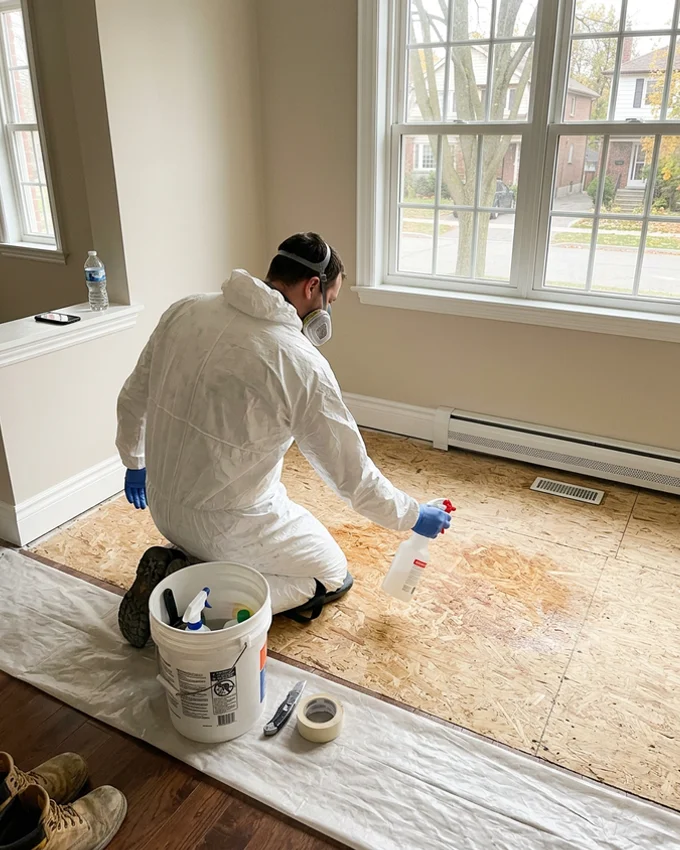
IICRC S540 response is the backbone of every crime scene job. First we assess, mapping visible and likely hidden contamination with lighting and moisture tools. Then we contain, using poly sheeting, zippered doors and HEPA negative air so the rest of the home stays clean. Removal follows: carpet, pad, upholstery, drywall and any porous item that absorbed fluids is cut out, bagged and manifested. Decontamination uses enzyme digesters to break down proteins, then hospital-grade disinfectants at full dwell time. Verification closes the job with ATP testing and a visual and odour check. Each stage is photographed, which gives your insurer a clear record of what was done.
Bloodborne Pathogen Decontamination (Structural Penetration, Subfloor Checks)
Bloodborne pathogen decontamination is where most of the hidden work sits. Blood flows into floor seams, under baseboards and into the gaps between hardwood boards, then reaches the subfloor or the ceiling below. We lift trim, open seams and check the subfloor rather than trusting what the surface shows. Affected subfloor is treated with enzyme cleaners and dry vapor steam, disinfected and, if needed, cut out and replaced. Crews wear cut-resistant nitrile gloves under outer gloves because broken glass and sharp debris are common. When the structure tests clean, we seal it with an encapsulating primer so your flooring trade can finish the room.
Owner & Family Handoff (Belongings Set Aside, Private Walkthrough)
Owner and family handoff is handled with as much care as the cleanup. Before removal starts, we ask what matters: photos, documents, jewellery, phones, keys, a favourite chair. Items outside the affected zone are cleaned and boxed. Items inside the zone are assessed, and anything non-porous is decontaminated and returned when it can be. We never discard personal effects without a photo record you can review. When the room is restored, you choose how the walkthrough happens: in person, by video call or not at all. Many families prefer to see the finished room first, and that is a perfectly good choice.
Police & Coroner Coordination (Scene Release Timing, Office of the Chief Coroner)
Police and coroner coordination keeps the family out of the paperwork. We confirm release timing with Toronto Police Service, Peel or York Regional Police, and when a death occurred, with the Office of the Chief Coroner for Ontario through the family’s contact. We do not start until the scene is released, and we never remove anything investigators asked to keep in place. If a detective needs a follow-up visit, we can pause and re-secure the containment. Landlords and property managers get the same single point of contact, so the unit is back in service without three different people calling the family.
When Toronto Properties Need Crime Scene Cleanup Fast
Homicide Scene in a Residential Property After Police Release
Symptom: Toronto Police Service has concluded forensic processing of a homicide scene in a home, rental unit or condo. The property is released to the owner or next of kin, but the room is still a biohazard with blood, tissue and body fluid. Family cannot bear to re-enter.
Immediate action: Obtain written police release before anyone enters. Secure the unit. Call us immediately on release so decomposition does not progress. Request the police investigator provide the next-of-kin contact information if the family is not local.
Scope: We coordinate with the family or executor, document the scene with time-stamped photos as released, remove biohazard material and affected flooring under OSHA 1910.1030, disinfect with sodium hypochlorite and quaternary ammonium chemistry, run HEPA negative air to prevent spore spread, ATP swab to verify biological cleanliness, and provide licensed biohazard carrier manifests. Typical crime scene cleanups $2,800 to $12,000, 1 to 4 days with crew of 2 to 4.
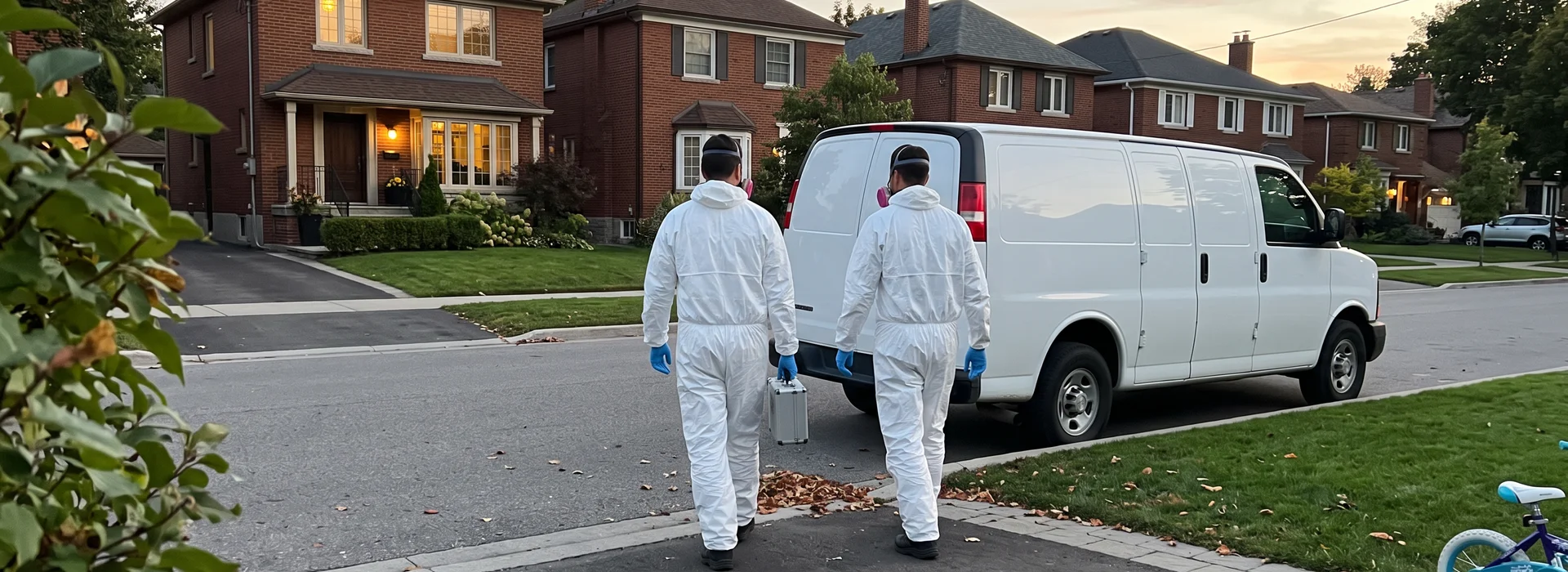
Qualified contractor response: Needs IICRC S540, OSHA 1910.1030, demonstrated experience working after Toronto Police release (not during investigation), unmarked vehicles so the property is not identified by neighbours, and discretion in communication with the family and building management. Must provide the biohazard disposal manifest for the insurance claim.
Suicide With Firearm or Other Trauma Requiring Structural Repair
Symptom: A suicide involving firearm, blade or significant trauma has left not just blood but structural damage. Walls, ceilings, flooring, upholstered furniture. Police investigation is complete, the family is in shock, and the physical scope of the cleanup is beyond standard biohazard.
Immediate action: Obtain police release before entering. Do not let family members see the room before cleanup. Have one family contact ready to make decisions on what to preserve vs replace. Call us within 24 hours of release.
Scope: We remove and dispose of all affected soft materials (upholstery, mattresses, bedding, carpet), cut out and dispose of affected drywall and sections of hardwood where fluid penetration occurred, disinfect studs and subfloor underneath, prepare the surfaces for restoration trades (drywaller, flooring installer), run HEPA and hydroxyl treatment on odour, and provide complete documentation for the insurance claim. Typical cost $5,000 to $18,000, 2 to 5 days with crew of 3 to 5.
Qualified contractor response: Needs IICRC S540 + OSHA 1910.1030 + experience with firearm trauma scenes (physical scope is different from medical death), coordination with restoration trades for the drywall, flooring and paint that follow, and the ability to deliver a scene ready for repair rather than an incomplete surface clean.
Assault or Accident With Blood Evidence in a Workplace
Symptom: A workplace incident (assault, serious injury, medical event) has left blood on floors, walls, equipment or shared areas. The business needs to reopen within 24 to 48 hours, employees are shaken, and WSIB may be involved.
Immediate action: Clear the area of all non-essential personnel. Do not let employees clean it themselves (WSIB violation and health risk). Document the scene with photos for insurance and WSIB. Call us for 2-hour emergency response if business continuity depends on same-day cleanup.
Scope: We arrive within 2 hours during business hours in Toronto, assess the extent of contamination, remove and dispose of any affected porous materials (fabric chairs, carpet tiles, cardboard), decontaminate hard surfaces with hospital-grade chemistry, verify with ATP swab, provide manifested disposal, and give the employer a sign-off letter stating the area is safe to reoccupy. Cost $1,500 to $6,500, same-day to 2-day turnaround with crew of 2 to 3.
Qualified contractor response: Needs IICRC S540, OSHA 1910.1030, WSIB-registered status (they will ask), ability to work during business hours or after hours as needed, documented chain-of-custody for the manifest, and a sign-off letter the employer can share with returning staff. Avoid any crew without WSIB registration. It blocks the workers’ comp claim.
What Families Should Know Before Calling
You do not need to clean, sort or even enter the room before we arrive. Keep the door closed, keep pets and children away, and call when the scene is released. For more detail, read what crime scene cleaning involves or our guide on who pays for crime scene cleanup in Ontario.