
The Question Every Owner Asks
Can floors be saved after animal hoarding? The honest answer to animal urine damage floors subfloor issues depends entirely on how deeply the liquid penetrated. We determine that depth through targeted testing rather than guessing.
You know how quickly the initial relief of clearing a property turns to panic when you finally smell what was hidden underneath. We hear this exact concern from property owners across the Greater Toronto Area every single week. Floor decisions are a massive part of any animal hoarding cleanup, and getting them right is crucial.
Current 2026 data shows that hoarding remediation in Toronto typically costs between $4,000 and $25,000 CAD. A large portion of that expense hinges on whether structural wood requires replacement. That potential $1,500 to $5,000 subfloor replacement fee is exactly why we test so carefully.
Let us look at how urine actually damages these materials.
We will break down the exact testing methods we use and the practical steps to handle the restoration.
Why Urine Damage Goes Deeper Than It Looks
Urine damage penetrates far beneath the visible surface because it acts as a delivery system for uric acid crystals, which embed themselves directly into the structural wood. We see floors that appear clean on top but remain entirely saturated underneath.
Our technicians frequently encounter this exact issue with cat urine subfloor contamination, which contains a much higher concentration of ammonia and acid than dog urine. The liquid portion of the waste eventually evaporates into the air. What stays behind are the uric acid crystals and sticky salts.
These elements bind tightly to wood fibres, carpet backing, the pad, the subfloor, and the lower drywall. They are completely unaffected by standard household cleaners. You cannot simply wipe them away.
The Hidden Biohazard Cycle
This creates a hidden biohazard. Over time, repeated accidents push the urine straight down through the finished flooring into the subfloor panels and the structural joists. Those embedded uric acid crystals are hygroscopic, meaning they pull moisture from the air. When the humidity in the room rises, the crystals reactivate and release that sharp ammonia odour all over again.
According to the Canadian Centre for Occupational Health and Safety, prolonged ammonia exposure from these trapped deposits creates serious respiratory irritation. This is the exact reason a room can look acceptable on the surface while remaining dangerous and foul-smelling underneath.
How We Decide What Can Be Saved
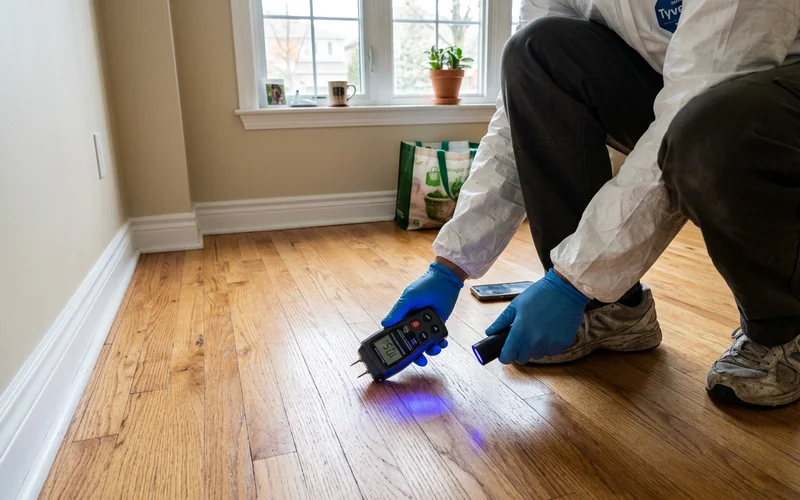
We determine which floors can be salvaged by combining visual UV inspections with deep-scanning moisture technology to map the exact contamination boundary. You should never guess when assessing structural damage.
Our process starts in the dark. High-intensity UV light is used to make invisible urine deposits glow vividly across the room. We follow this up with advanced tools like the Tramex MEX5 pinless moisture meter or spherical induction scanners.
These devices send an electromagnetic frequency up to 40mm deep into the material. This allows the detection of hidden wet pockets inside the wood without puncturing the surface. Once we have mapped the affected zones, we lift sample boards or cut small inspection openings to verify the conditions below.
| Flooring type | Often savable? | Notes |
|---|---|---|
| Carpet and pad | Rarely | Pad absorbs heavily, almost always removed |
| Sheet vinyl and linoleum | Sometimes | Urine often runs under seams to the subfloor |
| Laminate | Rarely | Fibreboard core swells and holds odour |
| Engineered hardwood | Sometimes | Depends on depth and finish |
| Solid hardwood | Sometimes | Can be sanded if urine stayed in the top layer |
| Ceramic or porcelain tile | Often | Grout may need cleaning or replacing |
| Concrete | Usually | Needs enzyme treatment and sealing |
Test, do not guess
Two rooms in the same house can have completely different damage. Testing room by room keeps you from replacing floors that could have been saved, preserving thousands of dollars in renovation costs.
When the Subfloor Must Go
We remove the subfloor entirely when the wood panels become physically soft, heavily stained, or saturated beyond what an enzyme treatment can break down. Minor surface damage can be treated, but structural failure demands a complete replacement.
If the urine has soaked completely through the oriented strand board (OSB) or plywood, that section has to be cut out and discarded. Leaving saturated wood under new flooring guarantees a massive odour return and risks structural weakening. When we do replace these sections, we strictly adhere to the Ontario Building Code requirements. The new OSB or plywood panels must be the correct thickness, typically 5/8-inch or 23/32-inch depending on joist spacing, to restore full structural integrity.
Sealing the Salvageable Wood
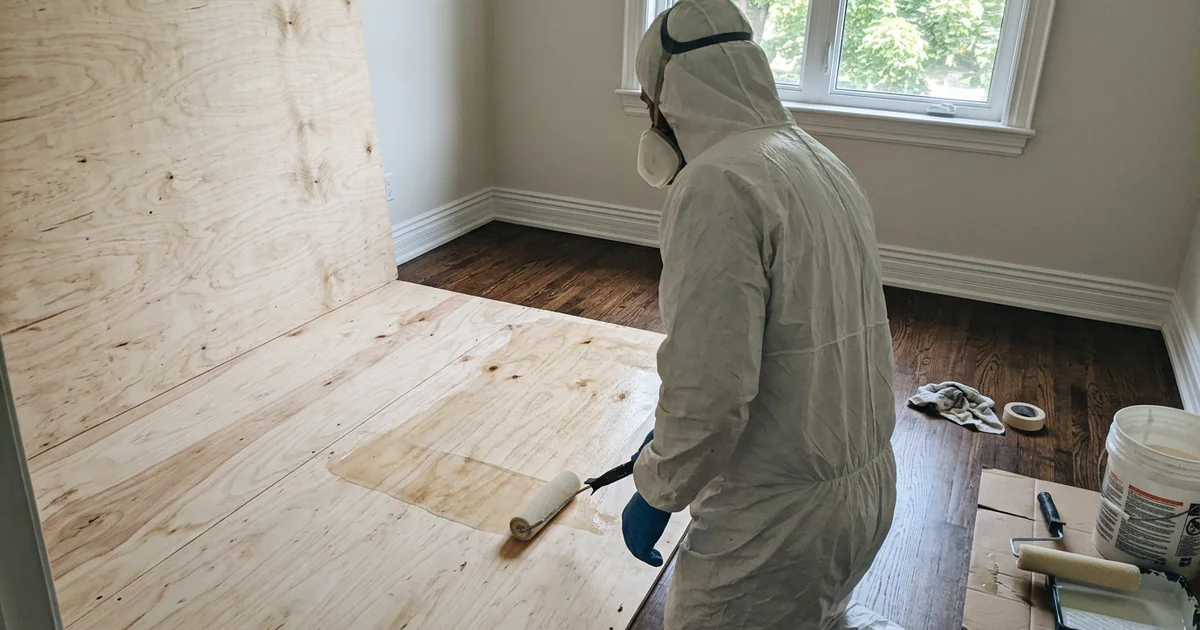
Sections that only show minor, surface-level staining are treated differently. We clean these areas with commercial-grade enzymatic digesters and allow them to dry fully.
Once the enzymes have neutralized the uric acid, the wood requires a strong sealant. Our preferred product for this is Zinsser B.I.N Shellac-Based Primer. This specific primer chemically locks in any residual odour molecules better than standard latex or oil paints.
We inspect the structural joists beneath the subfloor using the same criteria. Lower sections of drywall and baseboards that have absorbed urine are also removed immediately.
Enzymatic Treatment and Sealers
To successfully remove pet urine odour floors need to be treated with specialized multi-enzyme formulas that biologically digest the waste. Once the biological breakdown is complete and the wood is dry, a chemical sealer is applied to trap any microscopic traces that remain.
Enzymatic digesters do not just mask the smell with heavy perfumes. They rely on specific biological agents to dismantle the contamination:
- Protease Enzymes: These break down the complex protein chains found in the animal waste.
- Urease Enzymes: These specifically target and dissolve the stubborn uric acid crystals.
- Lipase Enzymes: These help break down any associated fats or oils left behind.
This process transforms the crystals into simpler, odourless compounds that can be extracted safely.
These enzymes require sustained contact to work properly. A thorough treatment needs a dwell time of 24 to 48 hours to fully penetrate the wood grain, which is why rushed jobs almost always fail. The enzymes must stay damp to keep working effectively.
Once the treated area has completely dried, the surface is sealed. We typically use a shellac-based product for this final step. Sealers act as a final barrier, but they are absolutely not a replacement for removing physically saturated material first. Our guide to the animal hoarding cleanup process explains where this fits in the full sequence.
Coordinating Flooring Trades
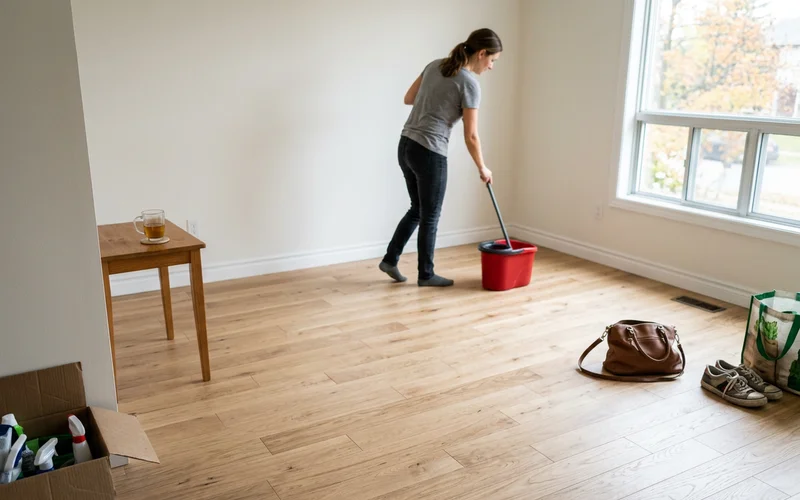
We only allow new flooring to be installed once the structural wood passes a final odour and moisture check on a warm, closed-up day. Laying new materials too soon will trap remaining moisture and void your flooring warranty.
We coordinate closely with trusted flooring trades, or we can hand off the site to your preferred contractors with detailed notes and photos. Before any new planks go down, the subfloor moisture content must be verified.
If you rush this step and install over damp wood, the trapped moisture will inevitably cause the new floor to buckle or gap. New flooring products, especially rigid core options, need 24 to 48 hours to acclimatize to the room’s specific temperature (ideally around 20 degrees Celsius) and humidity before installation.
Many owners choose to upgrade to an SPC (Stone Polymer Composite) luxury vinyl plank in rooms that suffered heavy hoarding damage.
We highly recommend selecting a product with at least a 20-mil wear layer for several key reasons:
- Waterproofing: SPC core vinyl is 100% waterproof, protecting the subfloor from future accidents.
- Durability: The thick wear layer is highly scratch-resistant against claws.
- Maintenance: The surface is significantly easier to keep sanitized if animals remain in the home.
What It Means for Cost
Flooring decisions represent the largest swing in your total cleanup budget, easily altering the final price by thousands of dollars. We price removal and replacement room by room so you maintain complete control over the expenses.
Animal hoarding cleanup costs in the Toronto area typically run anywhere from $4,000 to $25,000 CAD, depending heavily on the severity of the biohazard. The biggest variable in that range is the flooring material.
According to 2026 data, a standard subfloor replacement project costs between $1,500 and $5,000 on average. Contractors typically charge between $25 and $40 per hour for the labour to remove and rebuild the structural wood.
Making the Right Financial Call
Saving even one or two rooms of original hardwood or avoiding a full OSB subfloor tear-out makes a massive financial difference. That is precisely why blanket demolitions are a terrible idea.
We itemize the flooring removal and subfloor restoration in your written scope of work. You will see every single decision and its associated cost before our tools ever touch the ground.
Addressing these subfloor issues quickly is the best way to protect your investment.
Reach out to our team today to schedule a thorough moisture and UV inspection.